
Many new divers are confused by the number of different scuba training agencies, dive schools, and wonder which is the best scuba diving certification to get.
In this article, we will look at the best scuba training programs and discuss differences, similarities, and which one is “best”.
You will notice, however, that this question cannot be objectively answered and it is more important to find a good dive instructor, instead.
Best Scuba Training Agencies in 2026
These are the best scuba diving training programs and agencies in 2026:
- Most popular: PADI
- Most In-Depth training: CMAS
- Fastest Growing: IAC
- Great online courses: SSI
- Toughest Training: GUE
- Oldest Training Agency: BSAC
Let’s now look at each of them individually and how their pros and cons.
PADI – Professional Association of Diving Instructors
Most popular
PADI is by far the largest scuba training organization in the world and for many, a “PADI card” has become synonymous with becoming scuba certified.
It is recognized near everywhere and picking it as your training agency is never a bad idea.
They offer a large e-learning platform in all languages and you can begin any course anywhere and complete it at a different PADI dive base. Super convenient!
PADI Diving Courses Pros
- Biggest training agency in the world
- Recognized everywhere (very few exceptions)
- Easy referral program
- All languages available
- All courses available
- Online certification
PADI Diving Courses Cons
- Training very standardized
- Somewhat outdated training methods
- Tech & Cave training has poor reputation
- Cross-overs to PADI are a difficult (for no apparent reason)
Specs & Features
| Founded | 1966 |
| Types of Diving | Recreational Diving, Freediving, Technical Diving, Cave Diving, Disabled Diving, Children Diving |
| Organization Type | Owned by Altas Partners & Florac |
| Headquarters Location | California, USA (PADI Travel: Zurich, Switzerland) |
| Number of Dive Professionals | 137,000+ |
| Number of Dive Bases | 6,600+ |
| Certifications per Year | ~100,000 |
| Total Certifications | 29 million (as of 2021) |
| Online Course Library | Yes |
CMAS – Confédération Mondiale des Activités Subaquatiques
Most in-depth training
CMAS was founded in 1959 and is one of the oldest and most recognized scuba training agencies in the world.
CMAS courses are widely regarded as some of the most thorough and best dive training available and standards are much higher than at most other organizations.
As many CMAS dive bases are organized in clubs, training tends to last much longer, and CMAS courses are recognized anywhere in the world.
CMAS Diving Courses Pros
- One of the oldest training organizations
- Super in-depth dive training
- Very high standards
- Recognized anywhere in the world
- Includes freediving training
- Fewer courses needed
CMAS Diving Courses Cons
- Generally no online training
- Few dive bases in the world (mostly European countries & French territories)
- Can be tough for less athletic people
- “Stars” rule a little different from other popular agencies
Specs & Features
| Founded | 1959 |
| Types of Diving | Recreational Diving, Freediving, Technical Diving, Cave Diving |
| Organization Type | INGO (130 federations) |
| Headquarters Location | Rome, Italy |
| Number of Dive Professionals | Unknown |
| Number of Dive Bases | Unknown |
| Certifications per Year | Unknown |
| Total Certifications | Unknown |
| Online Course Library | No |
iac – International Aquanautic Club
Fastest Growing

iac (previously Baracuda) is a German scuba training organization that is currently the fastest growing one in Europe and the world
Iac offers anything from recreational to freediving, technical diving, and disabled diving and the course structure is in accordance to the guidelines of the RSTC.
It is also the only scuba training agency on this list that’s recognized and part of both the RSTC, as well as the CMAS and iac instructors (like myself) can issue certification cards for both.
iac Diving Courses Pros
- Young and modern approach to dive training
- Very personal support
- Super high standards
- Recognized anywhere in the world through RSTC & CMAS
- Curriculum very flexible
iac Diving Courses Cons
- No digital certifications (yet)
- Fewer dive bases than others on this list
- No general online course library (yet)
Specs & Features
| Founded | 1986 (as Baracuda), 2012 (iac) |
| Types of Diving | Recreational Diving, Freediving, Technical Diving, Cave Diving, Disabled Diving, Children Diving |
| Organization Type | Privately Owned |
| Headquarters Location | Essen, Germany |
| Number of Dive Professionals | 4500+ |
| Number of Dive Bases | 350+ |
| Certifications per Year | 10,000+ |
| Total Certifications | Unknown |
| Online Course Library | In progress |
SSI – Scuba Schools Internation
Great Online Courses
SSI is one of the most popular and recognized organizations in the world and recognized internationally.
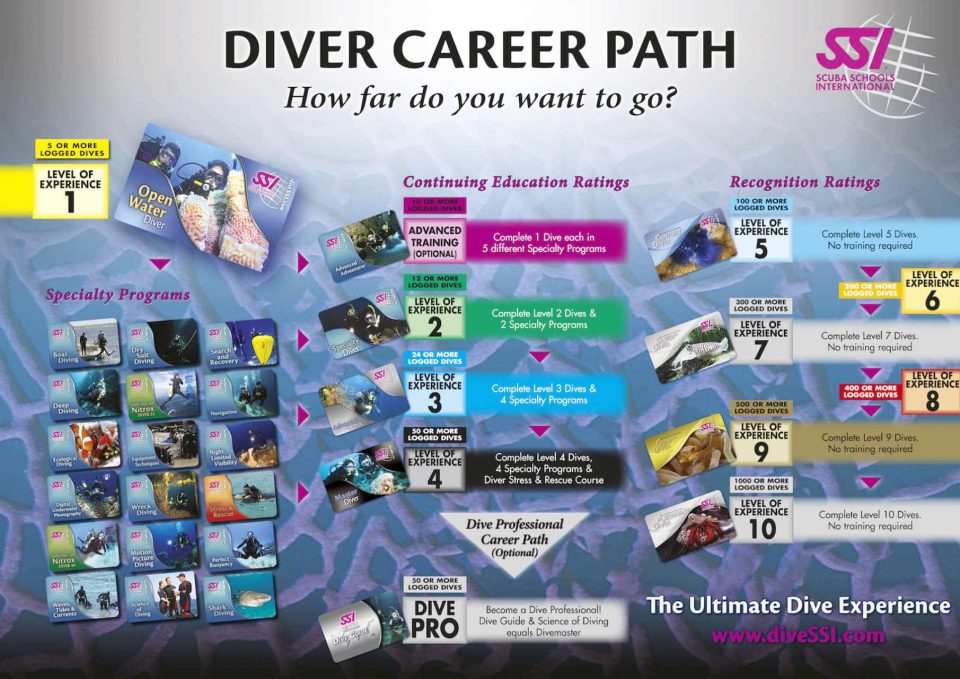
SSI has a different concept in contrast to PADI or CMAS, and all diving levels, as well as instructor levels, are based on diving experience rather than courses.
SSI courses are usually longer than other diving courses and I really like the extensive online course library and the SSI app.
SSI Diving Courses Pros
- Thorough dive training
- Training levels based on experience
- Cool online library
- Modern training approach
- Digital certifications & logbook
SSI Diving Courses Cons
- Courses often too long short trips
- Dive professionals must be connected to store
- Owned by same company as Mares, which can put off some people
Specs & Features
| Founded | 1970 |
| Types of Diving | Recreational Diving, Freediving, Technical Diving, Cave Diving, Disabled Diving, Children Diving |
| Organization Type | Owned by of HEAD |
| Headquarters Location | Colorado, USA |
| Number of Dive Professionals | 50,000+ |
| Number of Dive Bases | 3000+ |
| Certifications per Year | 30,000+ |
| Total Certifications | 800,000+ |
| Online Course Library | Extensive |
GUE – Global Underwater Explorers
Toughest Training
GUE is a technical diving agency that offers both recreational and technical dive training.
It is generally regarded as one of the toughest and most thorough training programs and GUE instructors pride themselves on exceptional skills and teaching approaches.
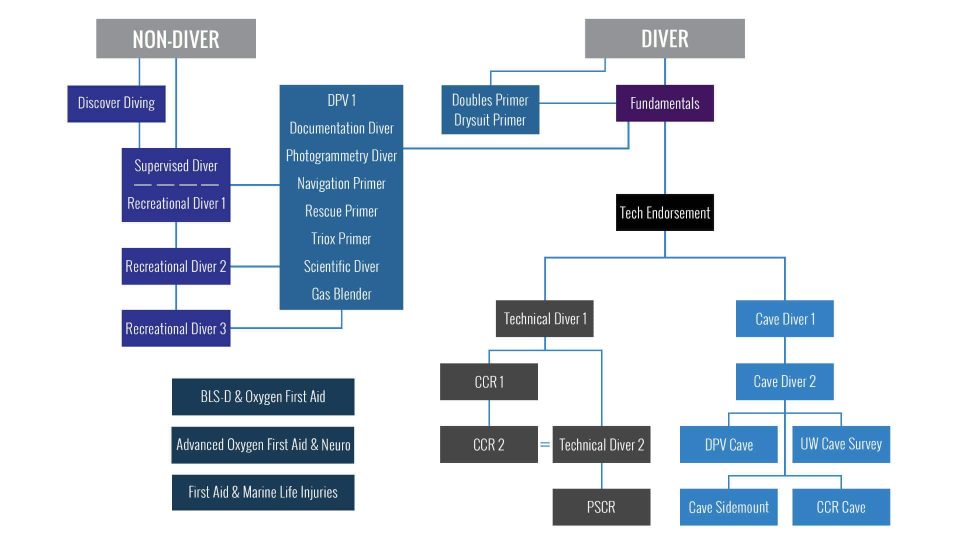
Their courses are structured differently from others on this list and often require greater commitment in terms of time, money, and equipment.
GUE Diving Courses Pros
- Exceptional training quality
- The most reputable cave & technical diving agency in the world
- Great for those who want to go from recreational to technical dive training
- Elite instructors
GUE Diving Courses Cons
- Can feel very restrictive
- Not as well-known in the recreational diving area
- Courses often expensive
- Very few dive bases and mostly individual instructors
Specs & Features
| Founded | 1998 |
| Types of Diving | Recreational Diving, Technical Diving, Cave Diving |
| Organization Type | NGO |
| Headquarters Location | Florida, USA |
| Number of Dive Professionals | <500 |
| Number of Dive Bases | Very few |
| Certifications per Year | Unknown |
| Total Certifications | Unknown |
| Online Course Library | No |
BSAC – British Sub-Aqua Club
Oldest Training Agency
BSAC is the oldest recreational dive training agency in the world and even precedes the CMAS by a few years.
It has been steadily declining in members and popularity for the past 20 years, however, most dive clubs in the UK are still part of BSAC.
They were the first recreational diving agency to use Nitrox as part of their core curriculum in all courses and most dive instructors are volunteers
BSAC Diving Courses Pros
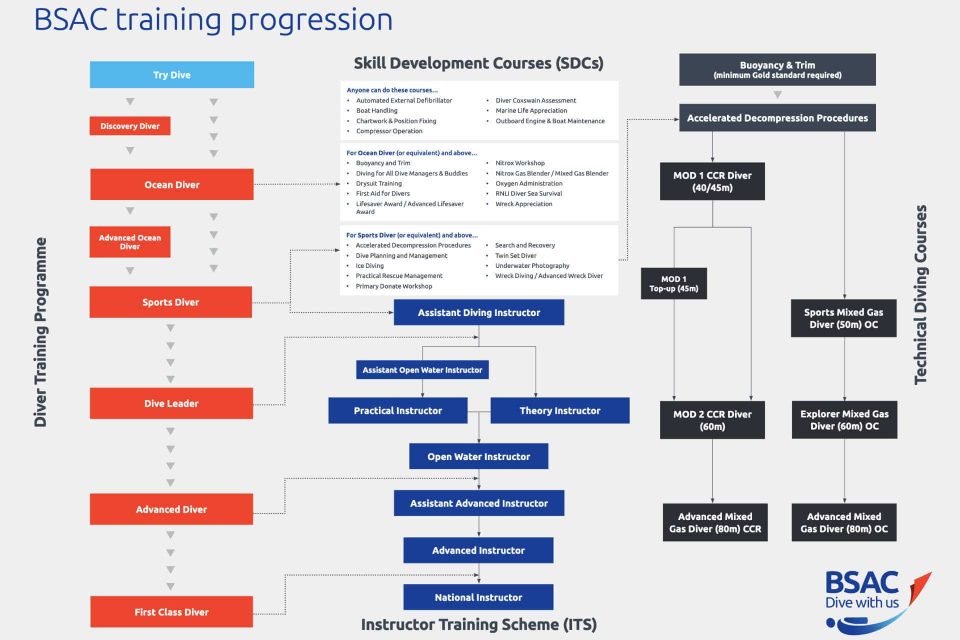
- Progressive course curriculum
- Great for those who want to join a dive club
- Oldest training agency
BSAC Diving Courses Cons
- Mostly aimed at UK divers
- Expelled from CMAS
- Not as recognized as more modern agencies
- Requires annual membership
- Requires club participation
Specs & Features
| Founded | 1953 |
| Types of Diving | Recreational Diving, Freediving, Technical Diving, Cave Diving, Disabled Diving, Children Diving |
| Organization Type | NGO |
| Headquarters Location | Cheshire, UK |
| Number of Dive Professionals | Unknown |
| Number of Dive Bases | ~400 |
| Certifications per Year | Unknown |
| Total Members | 27,000 (as of 2019) |
| Online Course Library | No |
Which Scuba Training Agency is Best?
There is no overall best scuba training agency as they all have strengths and weaknesses. Therefore, choose the one that best fits your goals and approach to scuba diving. If you want to dive a lot while traveling and do courses at different locations, pick a larger agency like PADI or SSI as they have lots of dive bases around the world and are recognized everywhere. If you want the most thorough training or get into tech diving, agencies like CMAS or SDI/TDI are great starting points.
Especially new divers always ask the question “which scuba training agency is best?” or “PADI vs xyz…which is better?“. To which my usual answer is always “the training organization doesn’t matter as much as the instructor”.
The instructor is much more important than the training agency.
There are amazing training programs out there, but if they are taught by a complete idiot, you won’t become a great diver.
On the other, there are some programs I don’t like at all, but know some of their instructors and can personally vouch for their great training quality.
As such, look for a good instructor or dive school first, and don’t worry as much about the agency.
The only time you really want to look closer at the training agency is when you get into technical diving or cave diving.
Here, there are big differences in terms of equivalency and reputation around the world.
Why are there different diving certification programs?
Scuba diving is not regulated by one general entity like pilot licenses, boat permits, or skydiving courses. Therefore, different scuba training agencies evolved which all offered their own training curriculum and courses to teach people scuba diving. Only in recent years through organizations like RSTC and CMAS has scuba training been more centralized and standardized.
There are many hundreds of different scuba training agencies with just as many scuba diving certification programs attached.
Although their training methods differ, they share one common goal: Teach people to scuba dive.
Therefore, the choice of certification program has a much lower effect on your diving career than you would initially think.
How do scuba training agencies differ?
Most scuba training agencies teach scuba diving in a similar way, starting with the theory, before moving on to pool training and finishing the course in open water. However, there are differences in training methodology, number of course dives, and certification steps when taking higher scuba training courses. Bigger agencies also tend to have other features like elearning, digital certification cards, and referral programs.
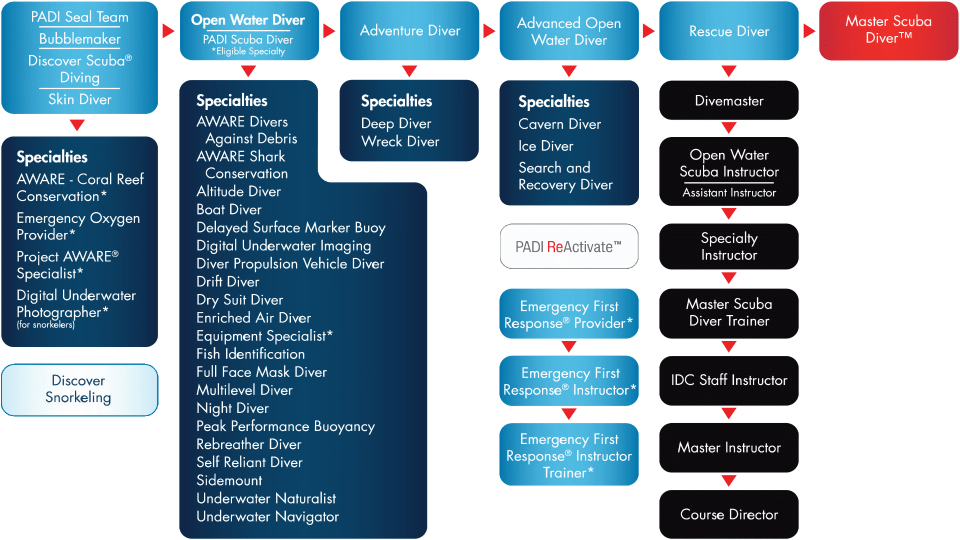
As you can see from the dive training flowcharts above, the way you progress through the dive training levels differs from agency to agency.
The Open Water Diver, as well as the Advanced Open Water Diver certifications are the most popular dive training certifications in the world. Most agencies offer them or variations thereof.
In the end, the name does not matter, as long as the training conforms to the respective ISO norms (24801-1 & 2) for supervised and autonomous divers. You can read more about them below.
To improve safety and minimum training standards, the RSTC was founded.
WRSTC – World Recreational Scuba Training Council
The World Recreational Scuba Training Council (WRSTC) is an organization of established scuba certification agencies that governs and develops worldwide minimum training standards for recreational dive training. It is made of smaller regional RSTC organizations and aims at improving safety and equivalency for scuba diving training.
We already discussed that the training organization is not near as important as the instructor and that most diving certifications are equivalent around the world.
However, I highly recommend you make sure that the dive school or training agency you’re with is part of the respective regional RSTC.
The RSTC is the closest thing we have to a world scuba diving organization and here, representatives of all major scuba diving organizations discuss training standards.
This means if your training organization is part of the RSTC, you can be sure that the diving course is accredited and fulfills the minimum criteria set by all its members.
RSTC members also automatically recognize each others’ training certifications as equivalent.
Scuba Certification Levels
Scuba diving certification levels are standardized by ISO (International Organization for Standardization) which ensures that there is equivalency between different scuba organizations and their training programs. ISO sets standards and norms for products and services in all areas and there are 5 ISO norms that apply to recreational diving services and training.
These are the ISO standards that are important for recreational scuba diver training:
- Introductory programs to scuba diving – ISO 11121
- Diver Level 1 – Supervised Diver – ISO 24801-1
- Diver Level 2 – Autonomous Diver – ISO 24801-2
- Diver Level 3 – Dive Leader ISO – 24801-3
- Enriched air nitrox diver training – ISO 11107
Introductory programs to scuba diving
ISO 11121 specifies the “minimum program content requirements for training organizations for introductory scuba experiences in recreational scuba diving“.
These are typically Discover Scuba Diving courses that do not qualify a person to dive on their own and are conducted in confined water environments like swimming pools.
Diver Level 1 – Supervised Diver
ISO 24801 is split into 3 parts and the first one is considered Diver Level 1 or “Supervised Diver”.
ISO 24801-1 specifies the competencies required of a scuba diver in order to obtain a scuba diver qualification from a training organization.
In practice, this refers to all basic diving qualifications that allow a diver to join guided dives under professional supervision. Most training agencies call them “Basic Diver”, “Scuba Diver”, or “Pool Diver”.
Unlike Open Water Divers, these divers must be accompanied by a diving professional like a Dive Leader or scuba instructor underwater.
Diver Level 2 – Autonomous Diver
ISO 24801-2 is the second diver level and the one we usually refer to when talking about general recreational scuba diving.
Starting at this level, scuba divers are certified to dive autonomously in buddy teams without professional supervision in open water.
Most scuba training organizations call this initial scuba certification Open Water Diver, however, there are also other equivalent ones like the CMAS* (read “CMAS 1 star“).
Diver Level 3 – Dive Leader
The final recreational scuba diver level is specified in ISO 24801-3 and refers to Dive Leaders and equivalent certifications.
These are all divers who may lead supervised divers (see above) on dives and is the highest recreational diver training level before getting into professional ones.
Enriched air nitrox diver training
ISO 11107 deals with recreational enriched air nitrox (EAN) diving and specifies requirements to be fulfilled before divers can use Nitrox gas mixtures underwater.
Are diving courses from different agencies equivalent?
Yes! In general, diving courses from different scuba training agencies are equivalent. This means that an Open Water Diver certification from iac is equal and equivalent to one from PADI, NAUI, SSI, and any other certified and accredited organization. In order to ensure this equivalency is recognized, get your scuba certifications from RSTC member organizations!
Can I switch from one to the other training agency?
Yes! Due to the equivalency of accredited diving courses, it is possible to switch between agencies and do courses wherever you like. You could, for example, do your OWD with PADI, your AOWD with SSI, but then decide to become a Dive Leader with IAC without problems. The same goes for specialty courses. You can also do the same course at two different agencies.
List of Scuba diving certification organizations
This is a list of most recognized scuba diving training organizations:
| Abbreviation | Name | Country | Website |
|---|---|---|---|
| ACDC | Associazione CMAS Diving Centre Italia | Italy | https://www.cmasdivingcenter.org/ |
| ACUC | American Canadian Underwater Certifications | Canada | https://acuc.es/en/ |
| BSAC | British Sub Aqua Club | UK | www.bsac.com |
| CMAS | Confédération Mondiale des Activités Subaquatiques | Worldwide | www.cmas.org |
| GUE | Global Underwater Explorers | USA | www.gue.com |
| IAC | International Aquanautic Club | Germany | www.diveiac.com |
| IANTD | International Association of Nitrox and Technical Divers | USA | iantd.com |
| IDA | Inernational Diving Association | Germany | www.ida-worldwide.com |
| NAUI | National Association of Underwater Instructors | USA | www.naui.org |
| PADI | Professional Association of Diving Instructors | USA | www.padi.com |
| PDA | Professional Diving Association | Germany | www.pdaww.de/en |
| ProTec | Professional Technical and Recreational Diving | Germany | www.protecdive.com |
| RAID | Rebreather Association of International Divers | Sweden | www.diveraid.com |
| SDI | Scuba Diving International | USA | www.tdisdi.com |
| SSI | Scuba Schools International | USA | www.divessi.com |
| TDI | Technical Diving International | USA | www.tdisdi.com |
| TVSÖ | Tauchsportverband Österreichs | Austria | www.tsvoe.at |
Conclusion
This concludes this comparison of the best scuba training agencies and hopefully answers the question which scuba diving certification is best: None of them are.
It all depends on what kind of diving you want to do and which approach suits your needs the most.
Remember: The dive instructor is much more important than the training agency.
However, it is highly recommended that you pick a training organization that’s part of the RSTC and fulfills their minimum training standards.
Join the email list to get regular diving tips, tricks, insights, and news straight to your inbox!
Always dive with friends and happy bubbles. 😃
Cheers
Julius