Cave diving is one of the most exciting, adventurous, and challenging forms of diving.
Exploring the dark, often narrow passages of caves requires extensive training and courage and it’s no wonder cave diving is widely considered the ultimate challenge for divers.
If you have been wanting to become a cave diver or think being an underwater explorer sounds cool, then you’ve come to the right place.
This guide seeks to shed some light on cave diving, how to get started, the necessary equipment, required certifications, and safety precautions.
What is Cave Diving?
In cave diving, you explore underwater caves, caverns, and other overhead environments using specialized scuba equipment. It is often regarded as the most challenging and dangerous way to dive, but it allows divers to explore often unknown or uncharted parts and unique environments.
Cave diving is as much a sport, as it is underwater exploration and thrill.
It’s about exploring the hidden realms beneath the surface, where ancient geological formations, crystal-clear water, and unparalleled silence await. Many underwater caves tell stories of Earth’s past, showcasing stalactites, stalagmites, and fossils.
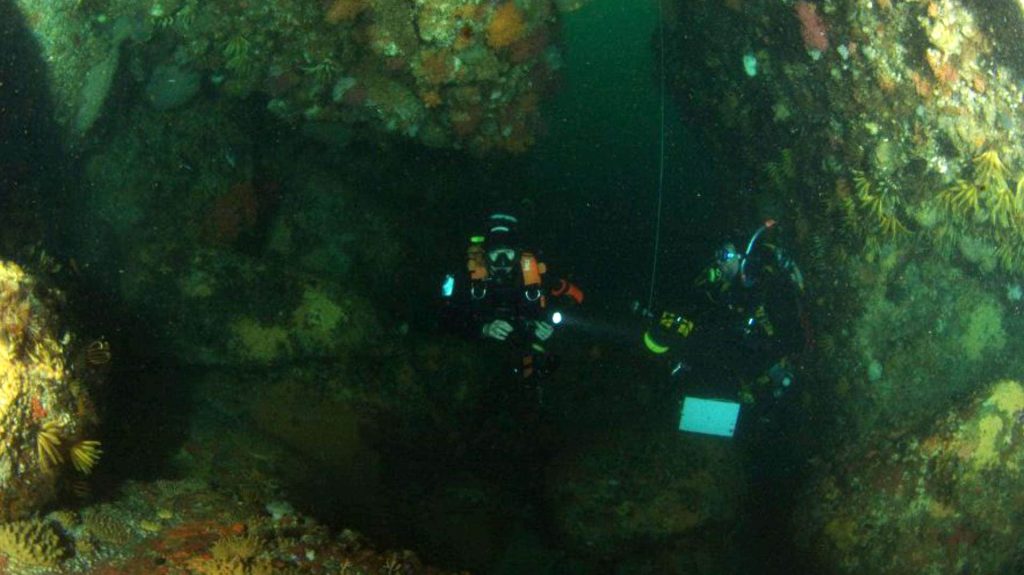
In other cases, you get to dive through flooded mines and their long abandoned heavy equipment or explore underwater wrecks that no one has entered since it sunk.
However, cave diving also comes with risks and is by far the most dangerous and even deadly diving discipline.
The challenges of navigating in an environment without natural light, potential maze-like structures, and dealing with equipment failures demand thorough training and experience.
Why Do People Love It?
Cave diving, for many, is the ultimate underwater frontier. The beauty and mystery of caves has always drawn people in and just because they are underwater…doesn’t prevent those who dare.
Let me tell you from experience that my first time diving in a cave (the Molnar Janos cave in Budapest, by the way), is still to this day one of the best memories of my life. 🤩
In that sense, cave diving is for many truly a life-changing experience.
Here are a few reasons why people absolutely love cave diving:
Sense of Adventure
Venturing into the unknown and exploring untouched underwater environments is something many divers dream of. After many years of diving, I still feel super excited when I dive down into a cave. Even the ones I have seen a dozen times before.
Thrill of Exploration
Cave divers follow guidelines underwater to find their way through cave systems. Once you reach the end of the line and explore further (while laying your own line), you are likely the first person (ever) to do so!
The idea of charting unexplored or lesser-known territories is enough for many to feel like true explorers such as the famous Jacques Cousteau.


A must-read for every Jacques Cousteau fan and ocean lover.
We earn a commission if you make a purchase, at no additional cost to you.
Unique Geological Formations
Some divers love reef formations, others enjoy sheer drop-offs, and caves offer yet a totally different environment.
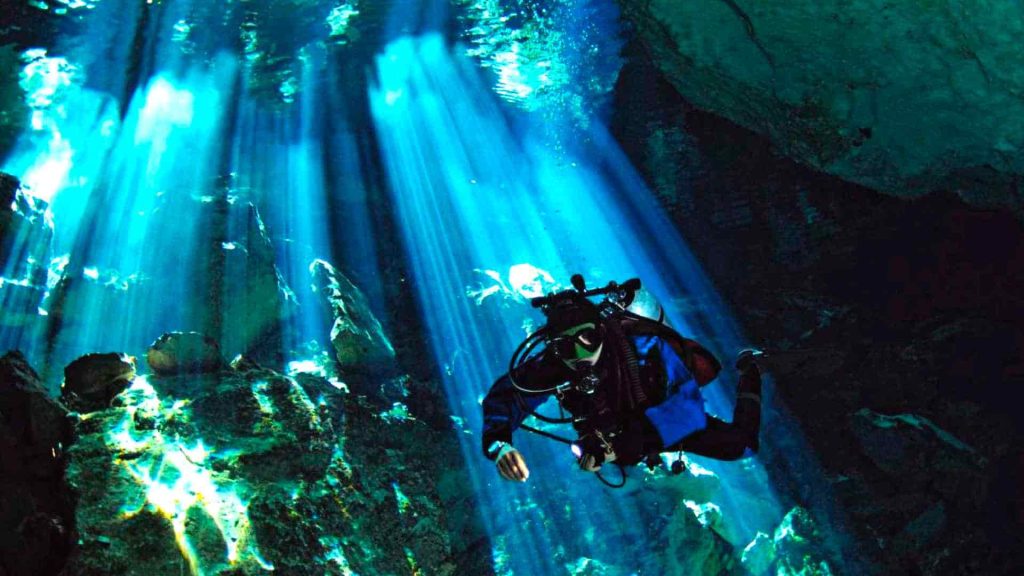
Underwater caves often house stunning stalactites, stalagmites, and other mineral formations rarely seen elsewhere. Just look at the famous cenotes caves in Mexico to get an understanding of what awaits.
Natural Beauty
The pristine, crystal-clear waters in many caves provide breathtaking visuals, enhanced by the play of light and shadows.
Of course, there are many caves with murky waters, but if the ground is left untouched for a long time, the water is as clear as it gets.
Challenge and Skill Mastery
The intricate and often unpredictable nature of caves challenges divers to become real masters of their skills. You need picture-perfect buoyancy, a good sense of direction and orientation, and a number of other skills to become a cave diver.
Scientific Discovery
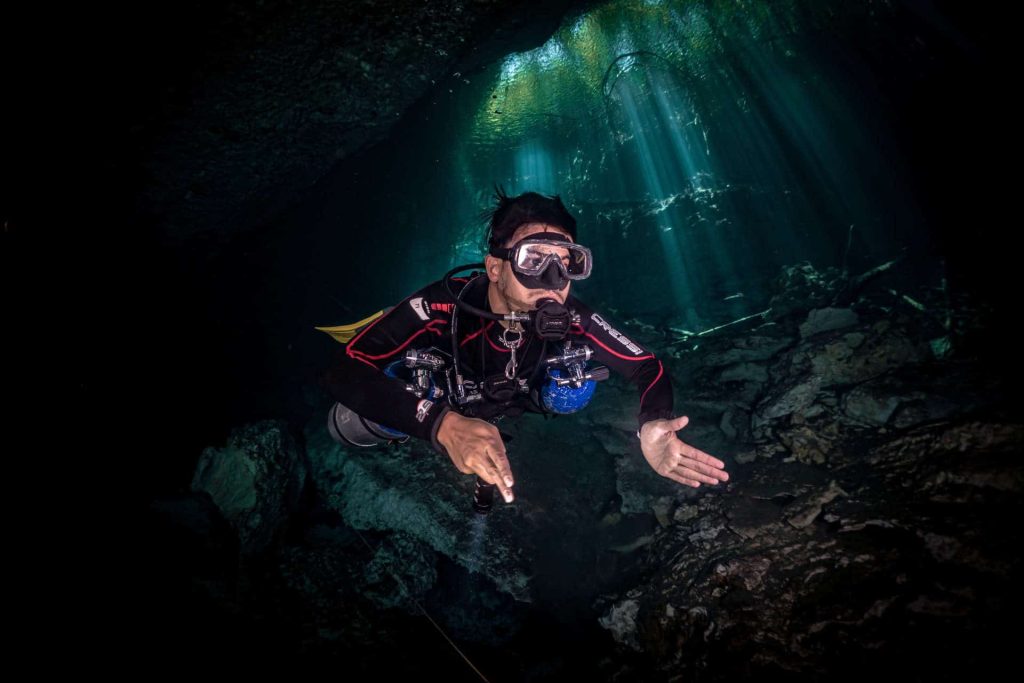
Some divers are drawn by the potential to discover new aquatic species or geological phenomena.
Historical and Archaeological Exploration
Sunken relics, fossils, and sometimes human artifacts in underwater caves offer glimpses into the past. Even now, divers still discover artifacts on a regular basis.
Seclusion & Meditation
Away from the regular dive spots, cave diving provides a sense of seclusion. Some people even call it a meditative experience, although I personally wouldn’t go that far.
Sense of Achievement
Successfully completing a cave dive, especially a challenging one, feels awesome! Similar to climbing up a mountain top, or achieving a freediving record!
Unique Environments
While caves are, well, the main environment cave divers dwell in, the same principles apply to any overhead environment. Among them are wrecks, mines, and even old nuclear reactors!
How do I become a Cave Diver?
To become a cave diver, you need to have excellent diving skills, use the required dive equipment like scuba gear, lines, and torches, and take special cave diving courses.
Before even thinking about becoming a cave diver, here are the fundamentals and requirements you should fulfill. They are also similar to what most cave diving training agencies require:
- At least Advanced Open Water Diver or Rescue Diver
- At least 50-100 (preferably more) dives in different environments
- VERY good buoyancy
- Good general diving skills like different fin kicks, helicopter turns, etc
- Experience with back-inflate wing BCDs
Optional but really handy:
- Technical Diving experience with mixed gases and decompression procedures
- Experience with drysuits and double-tank/sidemount configurations
Once you fulfill these requirements, you need to take cave diving courses up to the level required for the locations you wish to dive at.
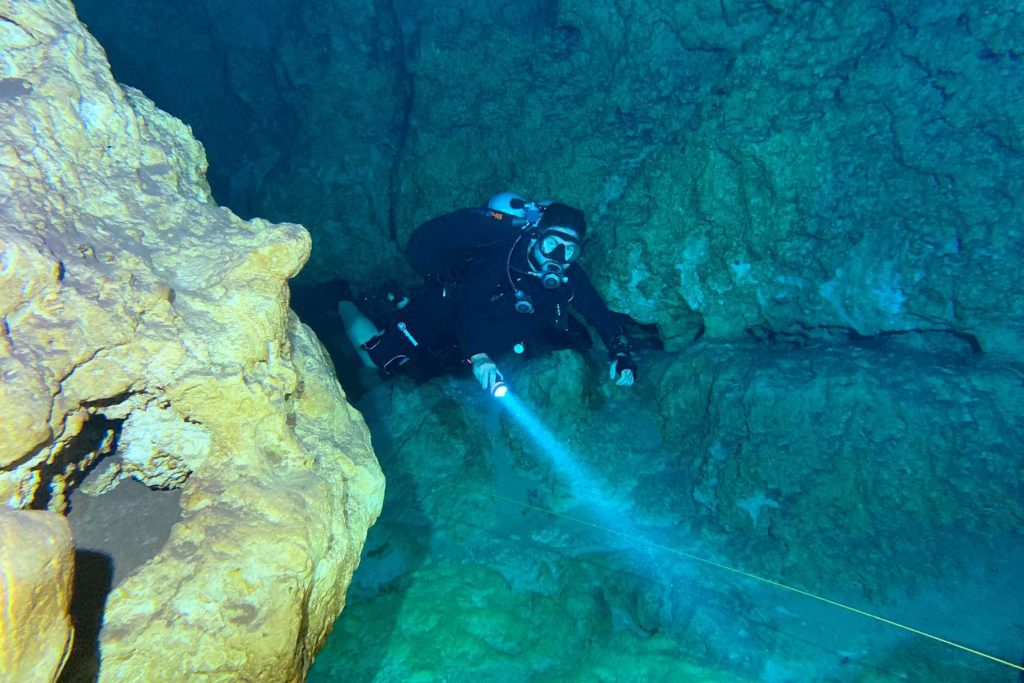
Last but not least, special cave diving equipment is required which is similar to that of technical divers.
Cave Diving Equipment
Cave diving requires special equipment similar to technical diving, with a few extras on top.
1. Specialized Scuba Gear
Standard scuba gear is often not adequate for overhead environments. Cave divers use durable tanks, usually made of steel, and carry multiple tanks for redundancy.
A back-inflate wing BCD is the standard required by most cave diving training agencies, as well as sidemount, double-tank, or rebreather configurations.
A good coldwater-ready regulator that can withstand some beating is equally important as scuba fins for frog-kicking.
2. Lights
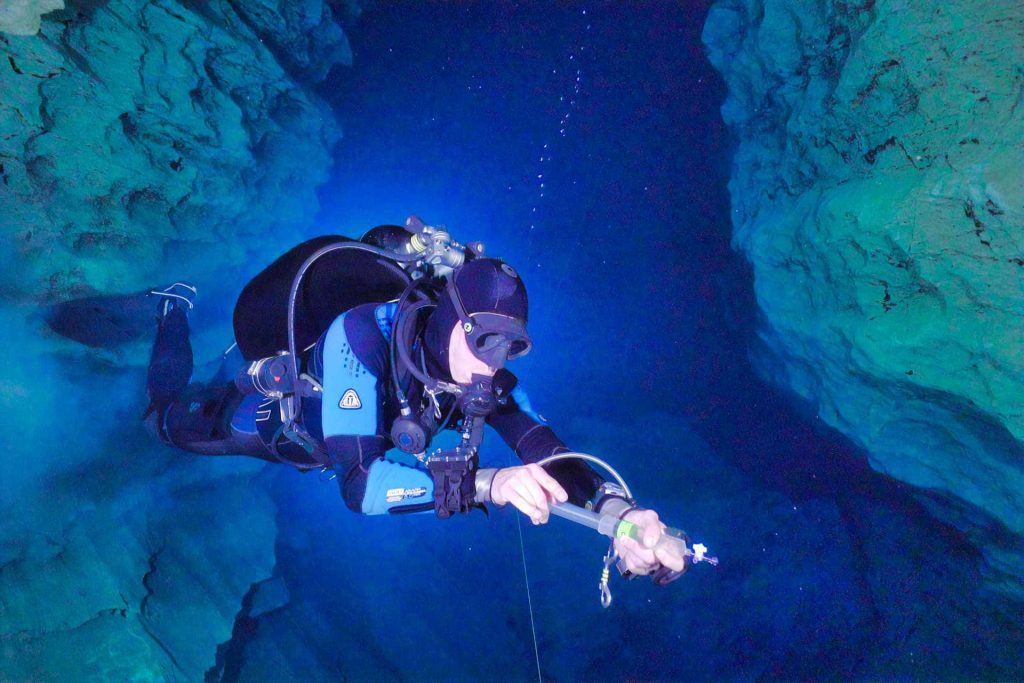
Primary and backup underwater torches are crucial for cave exploration. The primary light, usually wrist-mounted, is powerful and illuminates a vast area, while backup lights are used in case the primary fails.
3. Reels and Lines
Lines are used to mark a safe route in and out of the cave. A continuous guideline to the surface or open water is essential for safety and even though there might be one already at the dive site, cave divers carry their own, as well.
In addition, we carry direction markers and clips that are attached to the lines and at intersections to mark the direction to the exit.
4. Redundancy
Due to the potential risks, cave divers equip themselves with backup gear, including additional masks, regulators, and cutting tools.
5. Helmets & other exploration tools
Cave diving often leads us through VERY narrow passages and it isn’t seldom that we have to dig through mud or rocks to continue our dive.
Therefore, a good helmet and other exploration tools are needed at many caves.
Different Kinds of Cave Environments
There are many different kinds of environments to explore as a cave diver. It helps to understand what they are and which ones you are most interested in.
Here is a list of different environments, some examples of where to find them, and the certification required to dive in them.
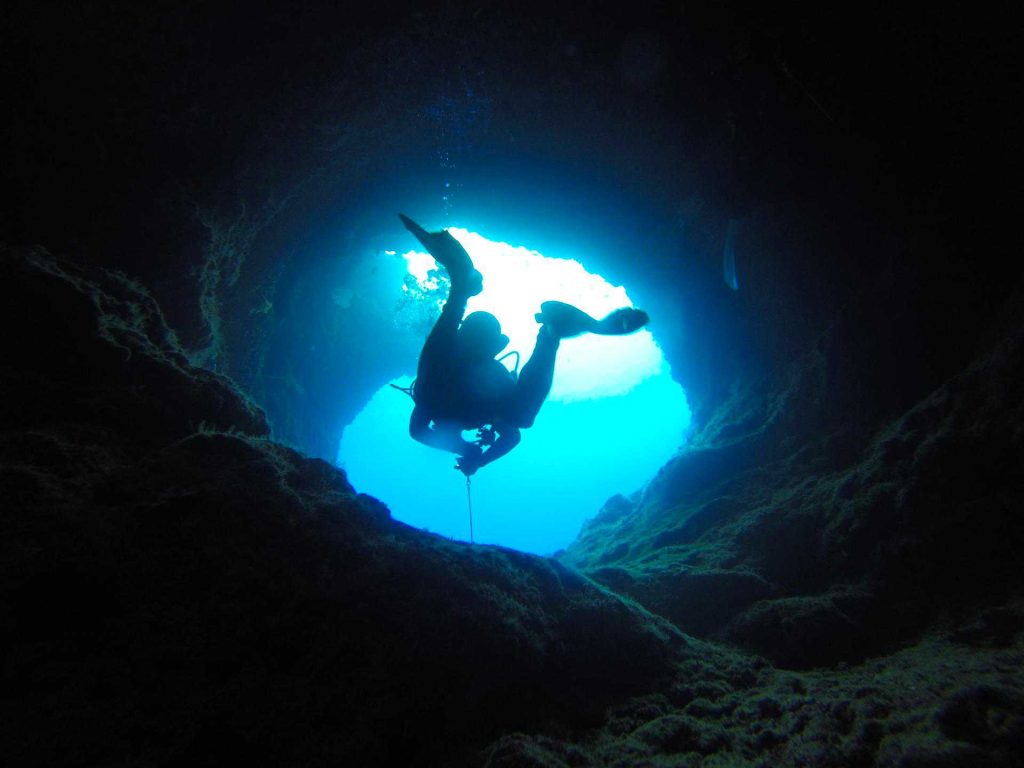
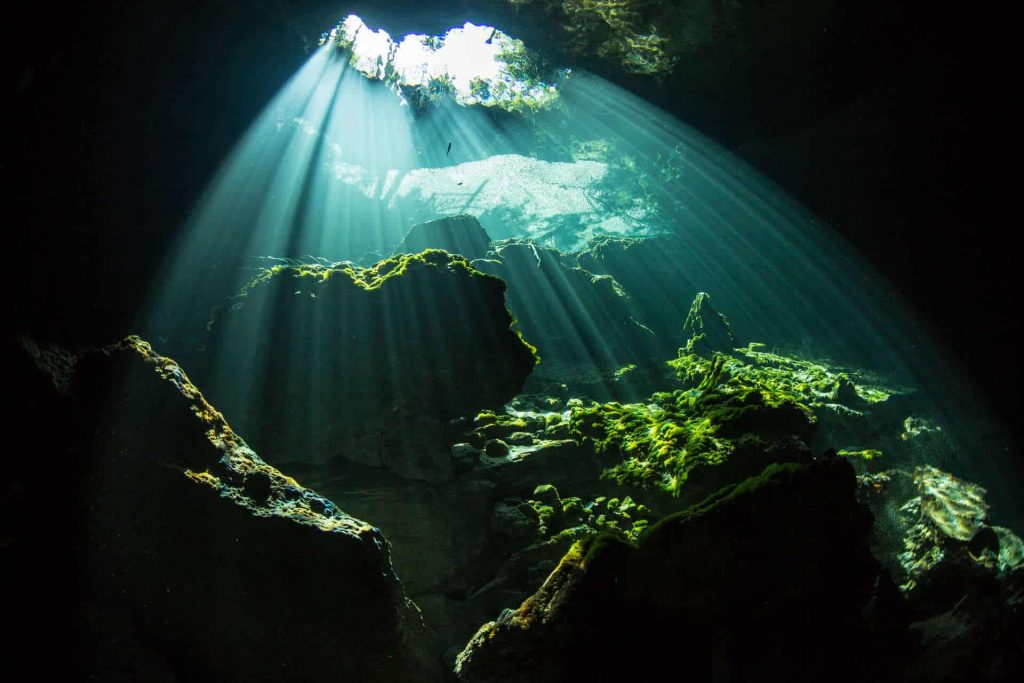
Caverns & Holes
Caverns are often not real “caves” per se but rather large holes that are still sun-lit to an extent.
They range from large hall-like caverns like in the famous Cenotes, to smaller ones you can see below.
Solution Caves
Formed primarily in limestone and other soluble rock, these caves are created by the action of rainwater and carbon dioxide. Over time, this slightly acidic water dissolves the rock, carving out vast chambers and tunnels.
Famous Examples/Dive Sites:
- The cenotes in the Yucatán Peninsula, Mexico.
- Florida’s underwater cave systems, like Ginnie Springs.
Certifications Required: Full Cave Certification. For most solution caves, divers will need to complete several courses that take them from introductory cave diving to more advanced techniques.
Lava Tubes
Formed by flowing lava which hardens on the surface while molten lava continues to flow beneath. When the eruption ceases, the flowing lava may drain out, leaving a tube-like structure.
Famous Examples/Dive Sites:
- The underwater lava tubes in Hawaii, especially on the Big Island.
- Iceland’s Silfra Fissure (though not technically a lava tube or even a cave, it’s a crack between the North American and Eurasian continents in the lava field).
Certifications Required: Advanced Open Water and Cave Diver Certifications. Some sites might also require Dry Suit Diver Certification given the cold water, especially in places like Silfra.
Fracture Caves
Created when the earth’s crust shifts and results in underground fractures or cracks. Over time, these cracks can expand, forming underwater chambers and tunnels.
Famous Examples/Dive Sites: Not as commonly dived as solution caves or lava tubes. They are more prevalent in regions with significant tectonic activity.
Certifications Required: Full Cave Certification, depending on the complexity and size of the cave.
Sea Caves
Formed primarily by wave action eroding coastal cliffs. They are not as intricate or deep as other cave types.
Famous Examples/Dive Sites:
- The Caves of the Sleeping Shark in Ibiza, Spain.
Certifications Required: Advanced Open Water Diver for most sea caves, though some may be accessible with a basic Open Water Certification. Specific training in overhead environments would be beneficial.
Sinkholes & Blue Holes:
These are vertical caves or shafts, often cylindrical, formed by the collapse of a cave roof or from chemical dissolution. They often lead to more extensive cave systems.
Famous Examples/Dive Sites:
- The Great Blue Hole in Belize.
- Dean’s Blue Hole in the Bahamas.
Certifications Required: Advanced Open Water Diver for most open sinkholes and blue holes. However, if venturing into the connected cave systems, Full Cave Certification will be needed.
Cave Diving Certifications & Courses
Cave diving absolutely requires special training, far beyond recreational diving.
And though each training agency provides slightly different courses, they all follow the same principles.
A typical progression starts with Cavern Diving, to explore semi-overhead environments and still sun-lit parts of caves. After that, an Introduction to Cave Diving course allows students to dive in confined and overhead cave environments but often without long decompression stops.
This is followed by more advanced courses, often called Cave Diver, and Full Cave Diver that delve into complex navigation, rescue techniques, and zero-visibility situations. They also allow divers to explore any cave and overhead environments using decompression procedures and even lay their own lines eventually.
Certain training agencies might offer slightly different course outlines for mine diving and wreck diving, but usually, they are very similar.
Here’s a list of common cave diving certifications and what they mean (loosely based on recommendations by GUE and IANTD):
Cavern Diver
This is the first step into the overhead environment. It focuses on basic reel and line techniques, buoyancy control, and safety procedures specific to caverns.
- Allows divers to: Explore the sunlit zone of caves, usually up to 40m / 130 feet from the entrance. No decompression diving is permitted.
Intro to Cave Diver
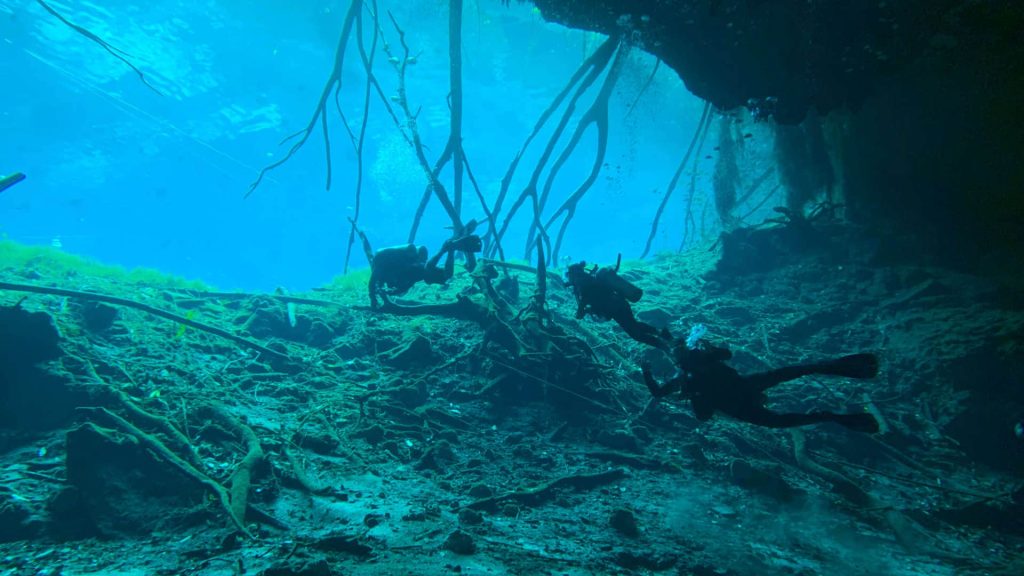
This course introduces divers to more advanced line techniques and basic cave navigation.
- Allows divers to: Go beyond the sunlight zone but limits them to the main line of the cave. Penetration is usually limited, and complex navigation (like jumps or gaps) is restricted.
Apprentice Cave Diver
This level builds upon the Intro to Cave Diver course and refines the skills learned previously. It’s a bridge between introductory cave diving and full cave diving.
- Allows divers to: Further their penetration into the cave system, make limited jumps off the main line, and become familiar with more complex navigation.
Full Cave Diver
This is the most comprehensive level of cave training. Divers learn advanced navigation, dive planning, and emergency procedures.
- Allows divers to: Explore deeper and more complex cave systems, make multiple jumps, and dive in areas far from the entrance.
Advanced Cave – Side Mount/No Mount
This is for very advanced cave divers looking to explore tighter cave passages.
- Allows divers to: Dive in extremely tight restrictions where traditional back-mounted tanks are not feasible. “No mount” involves pushing tanks ahead in spaces too tight even for side mount.
Advanced Cave – Stage Diving
This course teaches divers how to manage multiple gas supplies in the cave environment.
- Allows divers to: Use additional tanks (stages) to extend cave penetration range and bottom time.
Advanced Cave – DPV (Diver Propulsion Vehicle) Use
DPVs or underwater scooters can be a great asset, but also a potential risk in caves. This certification ensures divers can use them safely.
- Allows divers to: Use underwater scooters in caves to cover larger distances and reduce exertion.
Cave Surveying
This is often for those interested in contributing to the broader knowledge and documentation of cave systems.
- Allows divers to: Map and survey cave systems.
Cave Instructor & Cave Instructor Trainer
These are advanced professional levels in cave diving, allowing experienced cave divers to pass on their knowledge.
- Allows divers to: Teach cave diving courses and certify other divers.
Again, the progression may vary depending on the training agency. The number of dives required to reach each step is not fixed and depends on the instructor and the agency.
The instructor matters
Remember: The quality of your diving course is all about the instructor!
Cave Diving Training Agencies
While many recreational training agencies like PADI, SSI, iac, or NAUI offer cavern diving certifications, I urge you to look to one of the many special cave and technical diving training agencies.
Here’s a list of some of the most recognized cave diving training agencies worldwide:
GUE (Global Underwater Explorers)
Known for their rigorous training standards and emphasis on conservation, GUE offers both cave and technical diving courses.
Website: https://www.gue.com/
IANTD (International Association of Nitrox and Technical Divers)
Offers a range of technical diving courses, including cave diving. They’ve been pioneers in the field, especially when it comes to the use of enriched air nitrox (EANx) and trimix in cave environments.
Website: https://iantd.com/index.php/en-us/
Technical Diving International (TDI)
While TDI provides training across all forms of technical diving, they have a strong emphasis and comprehensive curriculum for cave diving.
Website: https://www.tdisdi.com/tdi
NSS-CDS (National Speleological Society – Cave Diving Section
One of the oldest and most respected cave diving organizations in the world, but mostly active in the USA. They offer a wide range of cave diving courses, from beginner to instructor levels.
Website: https://nsscds.org/
Safety Precautions
Safety is paramount in cave diving!
The primary rule is to always maintain a continuous guideline to open water. This line ensures that divers can find their way back, even in zero visibility situations.
Secondly, the ‘rule of thirds‘ is a standard practice: Use one-third of your air supply for ingress, one-third for egress, and keep one-third as a reserve.
Always dive with a dive buddy and ensure both are adequately trained and equipped.
Regularly inspect and maintain equipment, and always have a clear dive plan, including understanding the cave’s layout, potential hazards, and points of exit.
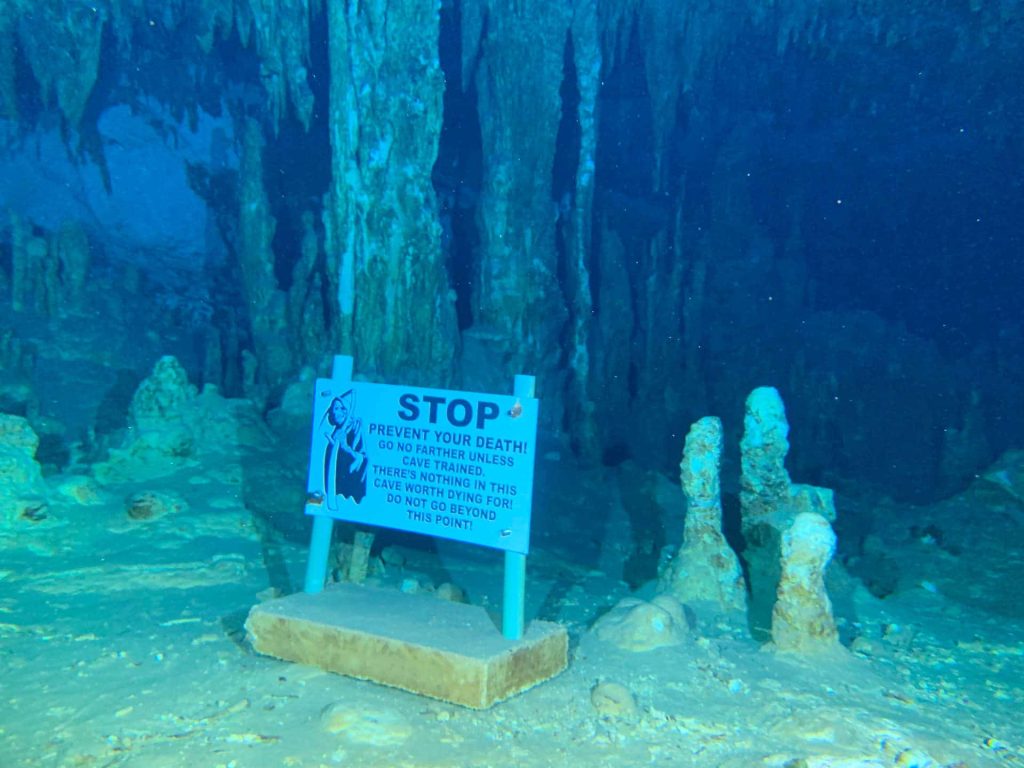
Is cave diving dangerous?
Cave diving is considered one of the more hazardous forms of diving due to various unique challenges. This includes zero visibility, tight spaces, complex navigation, and overhead environments, which prevent a direct ascent to the surface in case of an emergency.
There is no other way of saying it: Yes, cave diving can be very dangerous and even deadly. Diving Medicine for Scuba Divers estimated in 2015 that 5% of all scuba diving fatalities involved cave diving.
Anyone who says there is no risk involved is lying. There, I said it.
However, all cave diving is not created equal.
Many people dive in caves for decades without ever experiencing dangerous situations or accidents. However, the more extreme (or stupid) people become, the more dangerous it gets.
Most accidents are usually caused by people who are either not certified to dive in caves, carry the wrong equipment, or overestimate their abilities.
Remember:
Only dive in caves if you are certified, equipped, and prepared to do so!
It’s also important to differentiate between recreational cave diving and exploration. The majority of fatal accidents by certified cave divers happen during explorations.
Therefore, while cave diving poses serious risks when done wrong, there are safe ways of doing it.
Conclusion
Cave diving is a truly unique and challenging experience.
I hope you learned something in this guide and know how to get started. If you have any questions, let me know!