
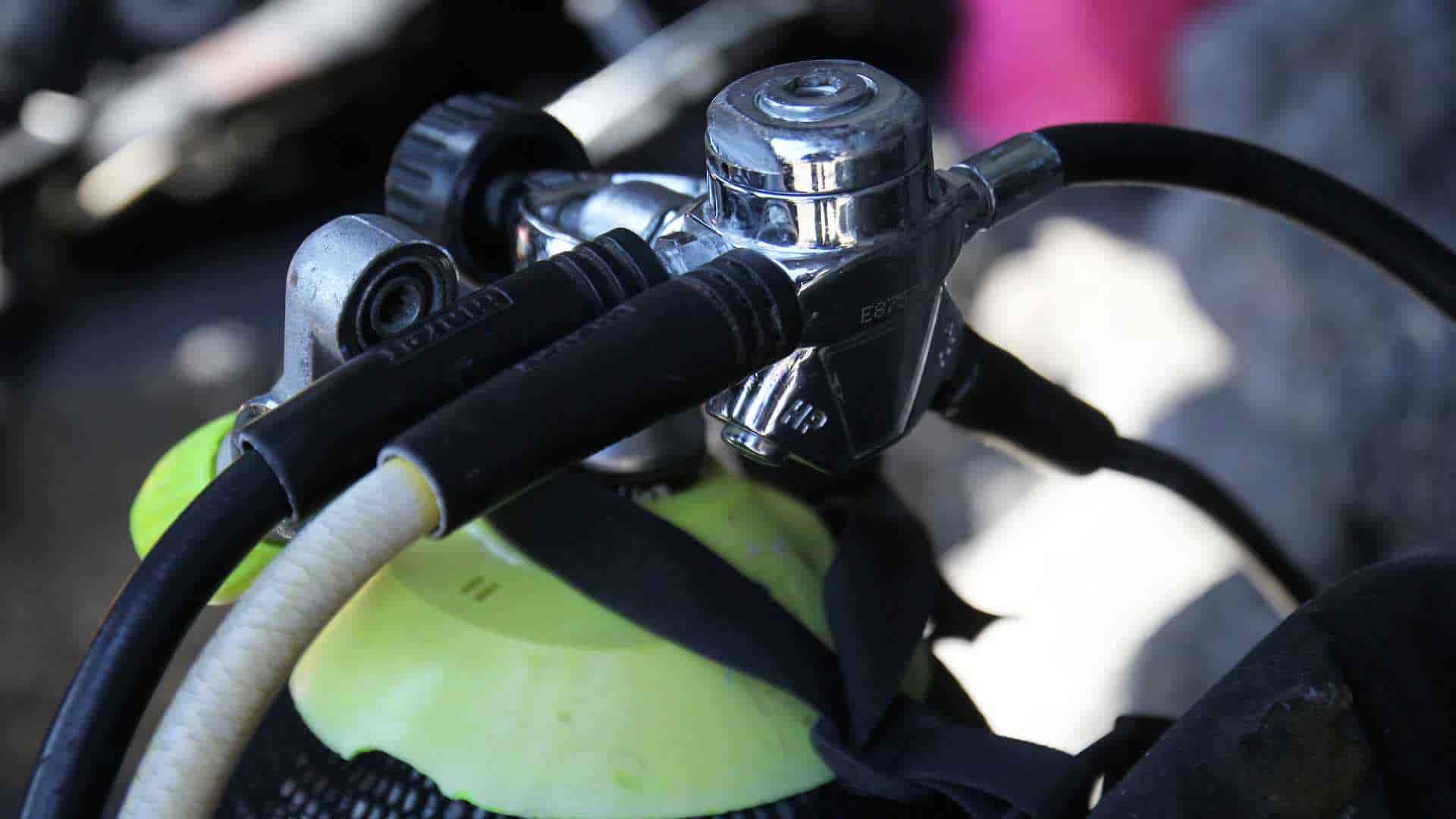
Once you start to buy your very own scuba gear, you also need to make sure it’s in good shape at all times.
Especially critical pieces such as the scuba regulator, your BCD, and the scuba tank need to be well maintained and serviced regularly.
However, even smaller pieces need to be cleaned at stored away correctly, or you will one day start your dive with a hole in your dive boots or a broken scuba mask frame.
Let’s look at each of the dive equipment pieces and check out how to take care of it, how often you need to get it serviced, and what else you can do to extend its lifespan.
Scuba Gear Maintenance Chart
Below you find a quick chart on how to maintain each piece of your dive equipment and whether it requires regular service by a professional.
| Part | Cleaning | Storage | Service Interval |
|---|---|---|---|
| Scuba Mask | Rinse with freshwater | In mask box, dark, dry | – |
| Snorkel | Rinse with freshwater | No special requirements | – |
| Scuba Fins | Rinse with freshwater | Flat or on heels, never on fin tips | – |
| Dive boots | Rinse with freshwater | No creases, dry | – |
| Wetsuit | Rinse with freshwater, hang up to dry | On wetsuit hanger, dark, dry, no creases | – |
| Scuba regulator | Rinse with freshwater, never flood first stage! | Regulator bag or hanging down, clean out filter first | Every ~1-2 years / 100 dives professional service |
| BCD | Rinse with freshwater, wash out & empty bladder | On hanger or folded | Every ~1-3 years visual inspection |
| Scuba Tank | Blow out valve with air | Standing up, long-term: Half empty | Every ~3-5 years professional service |
| Drysuit | Rinse with freshwater, clean zipper | On drysuit hanger, dark, dry, no creases, lube zipper | regular visual inspections |
Scuba Regulator Service
Scuba regulators must be serviced by a professional every 1-2 years, depending on the model. Most manufacturers recommend more frequent service intervals when diving more than 100 times a year. Failure to get your scuba regulator service will void the warranty and can potentially be dangerous as o-rings can tear and water may enter the valves.
Regulator servicing is super important and should not be neglected.
Most regulators have a mandatory service interval of 1 year, while more expensive ones require a service every 2 years.
The only exception to this is the Atomic Aquatics T3 which has a 3(!) year interval.
If you dive very frequently and more than about 100 times a year, you should get your regulator serviced every 6-12 months.
DO NOT do the service on your own and get it done at a certified dealer!
It should also be noted that some dive insurances will see it as gross negligence if you neglect to get your scuba regulator serviced in time.
BCD Service
BCDs have similar service intervals as scuba regulators, however, unlike them, you won’t usually void the warranty or risk insurance troubles if you wait a little longer.
In most cases, a visual inspection is sufficient and the price is much lower than for a regulator.
Most importantly, if both bladder and harness/BCD are intact, only an o-ring replacement is needed which can be done for as low as €30-50.
7 Things to Avoid
Here are 7 general tips on things you should absolutely avoid when maintaining, storing, and traveling with your dive equipment.
I see these all the time, but I hope you won’t fall for them.
1. Disassembling your regulator
Please keep your scuba regulator in one piece and don’t disassemble it, replace parts of it, or alter it in any way. Not only will this void the manufacturer warranty, but can also be dangerous.
2. Folding your wetsuit
Wetsuits are meant to be stored flat or hanging on a wetsuit hanger.
Folding them will create creases and can potentially damage the material.
3. Leaving your dive equipment in direct sunlight
UV light will break down rubber, neoprene, and fabric and damage your equipment.
Find a place in the shades, and avoid exposing your scuba gear to direct sunlight.
4. Storing your equipment away while it’s still wet
This is a perfect way to ruin your scuba gear really fast.
Bacteria love warm, humid places and your equipment will start smelling awful or even start to rot. Metal parts will become rusty and degrade quickly.
I once left a few weight pieces in a box with a little water in it for a few months in my basement…and trust me, both the smell and the look of it after were very unpleasant.
5. Leaving scuba gear on the floor
Don’t do it. Please. You WILL step on something and break it inevitably.
6. Pressing the purge button underwater on an unpressurized regulator
You should have learned in your Open Water Diver course that this will flood the first stage with water which requires a full service.
7. Dropping your tank pressure below 20 bars underwater
Doing so increases the possibility that water and moisture enter the scuba tank and it will start to rust or rot on the inside.
Therefore, all dive bases I know have a rule that all cylinders must be returned with 30 bars+ after every dive.